
I was scrolling for some News about AI to take some new insightful news about AI, and suddenly I found about “Egocentric Data Hostpot”. I got curious about what this new Rising conversational issue everyone is talking about,
SO I THOUGHT OF SHARING IT WITH MY READERS
For the past few years, whenever we talked about artificial intelligence, we were usually talking about screens. We watched apps like ChatGPT write essays, code software, and generate images from text prompts.
But behind the scenes, the tech world has quietly shifted gears. The new gold rush isn’t about teaching computers how to type; it’s about teaching them how to move around, use tools, and survive in the real world.
If you follow tech news, you might have noticed a strange new phrase popping up lately: Egocentric Data Hotspots. It sounds like total gibberish, but it’s actually a really cool concept. Tech giants are suddenly obsessed with watching how humans use their hands, and it’s completely changing the future of automation. Here is what is actually going on — minus the annoying academic language.
What on Earth is “Egocentric Data”?
To understand why this is a big deal, you first have to realise that robots are traditionally pretty bad at seeing things the way we do.
For decades, engineers have trained AI using what they call exocentric data. Think of this as the “third-person view” — like a security camera mounted on a wall or a camera on a tripod watching a chef cook from across the room.
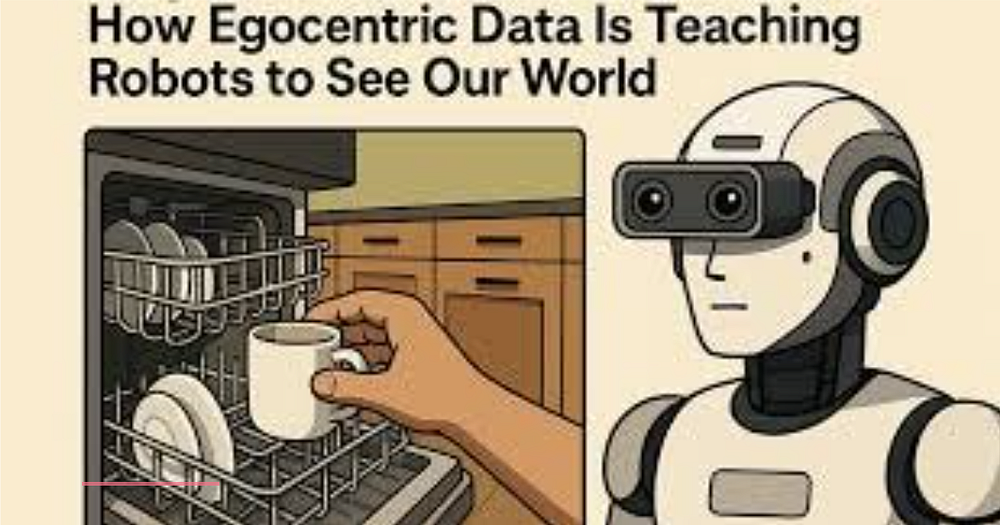
Egocentric data is the exact opposite. It’s pure, first-person perspective. It is a “point-of-view” (POV) video captured by wearable tech like smart glasses, chest cameras, or headset recorders. It records exactly what a human’s eyes are tracking and precisely how their hands move to get a job done.
What Makes it a “Hotspot”?
When tech companies talk about a hotspot here, they aren’t talking about your phone’s internet connection. They are talking about a visual heatmap.
When a human wears a camera while working, an AI analyses the footage to find the exact spots where the human’s hands touch an object — like the handle of a mug, the trigger of a drill, or a dial on a control panel. These are “interaction hotspots.” They teach the AI exactly where to grab and how much care is needed to move an object safely.
- The Third-Person View (Security Cam style): Sees the whole room from a distance. The problem? It’s incredibly hard for a robot to watch someone from across the room and figure out how to position its own hands to do the same thing.
- The First-Person View (POV style): Sees exactly what your eyes and hands see. The breakthrough? The video shows the exact angle the robot will see when it tries the task itself. It removes all the guesswork.

Why is Everyone Talking About This Right Now?
Two major trends are pushing this into the spotlight:
1. The Humanoid Robot Boom
We are seeing a massive wave of companies building humanoid robots designed to work in our warehouses, factories, and homes. To make these robots useful, engineers use something called Vision-Language-Action models.
Basically, you tell the robot, “Please grab that wrench,” and its brain instantly translates those words into physical arm movements. To train these robotic brains, companies need millions of hours of video showing exactly how human hands interact with tools. POV video is the perfect textbook for them.
2. Real Life is Messy
Robots do great in closed factories where everything is perfectly clean and predictable. But put a robot in a messy kitchen or a crowded warehouse aisle, and it panics. Shadows change, boxes get stacked weirdly, and things get dropped. By watching hours of real humans dealing with these everyday annoyances via POV cameras, AI is finally learning how to handle the chaos of the real world.
The Dark Side: The Workplace Privacy Dilemma
Of course, this trend isn’t without controversy. It has sparked a pretty intense debate about workplace privacy and worker rights.
The Automation Paradox: In many warehouses and industrial plants, workers are being asked to wear cameras or smart glasses under the guise of “safety training” or “productivity tracking.” But employees are starting to realise a harsh truth: by recording every micro-movement of their hands, they are actively training the very robots meant to replace them.
There is also the simple creepy factor. When a company logs your exact point of view for eight hours a day, they aren’t just watching the machinery. They are tracking how often you look away, how long your breaks are, and exactly how fast you work down to the millisecond. It crosses a line from helpful data collection into extreme surveillance.
The Bottom Line
The buzz around egocentric data hotspots proves that AI is growing up. For a long time, we adjusted our lives to fit into the digital world of computers.
Now, the computers are trying to fit into ours. By looking through our eyes, AI is transitioning from a tool on a screen to a machine that can walk alongside us. Whether that makes our lives easier or makes the workplace a lot more stressful is a story we are going to see play out over the next few years.
Do share, what’s your take on this rising issue??
Leave a Reply